

Remembering Life Cross-the-Creek in the 1950s and 1960s: A Conversation with Floyd Richardson
Ed. note: Mr. Richardson is now living in Highland Park, Michigan, a suburb of Detroit. The remembrances that follow were recorded Wednesday, Oct. 15, 2025 in a conversation with James Salter and Kathy King. The historic Cross-the-Creek neighborhood has been home since 1913 to Shiloh Missionary Baptist on Selma Road, and was site of the Black business district during the Jim Crow Era. – kk & js
Born in 1949, Floyd Richardson spent the first seventeen years of his life in Montevallo. He lived right behind Shiloh Baptist, on Ellis Street, in the historic neighborhood still informally known as Cross-the-Creek. He remembers it warmly as “a very good community. You know, everybody looked out for each other, cared for each other.”
Before moving to Michigan in 1967, he attended Prentice High School, and loved it. “It was great, because it was all Black students.” To this day he is struck, first and foremost, by the excellence of his teachers. “They wanted us to succeed. And it was wonderful. I had some great teachers there.”
Two men in particular left a lasting impress. They wanted the best for their students. Mr. Rudolph Belisle was “definitely a character.” He was funny, eager to get involved with his students, whether in the gym or his civics classes. He had an unconventional approach to things – “but you learned.”
Mr Belisle is famous for waging a creative campaign against cheating. He would sit at the desk like he was asleep but always with an eye out. The most notorious tool in his anti-cheating arsenal was a ladder he kept on the outside of the building. He would leave the room, saying “no cheating, no this and that.” But he would head directly for the outdoors. “And you’d look up and he’d be peeping in the window from the outside.” “Yeah,” he sums up, “he was a character – but a very good teacher.”
The other teacher he particularly admired was Mr. Frank Green, a “good guy” and “no-nonsense type of teacher” who also coached basketball. Like the other teachers, he wanted the best for his students. He would help you in any way he could. He would give assignments that enrichen you. “He was one of the best men that taught at Prentice.”
The principal at this time was Mr. George Dailey, a man Floyd saw as little as possible. (He preferred to stay out of trouble.) But he did recall one amusing exchange. “We had a pretty good basketball team,” he tells us, “and this was the time when integration was beginning to start in the South, and we tried our best to get him to try to schedule a basketball game between Montevallo High and Prentice High. He said, Do you want to get somebody killed?’ [We all laugh.] No, he said, that would not work.”
The legendary Blanche Coger was another character, a very good teacher but in Floyd’s view, too strict. She was “always telling you how – excuse my language – how she beat your butt like she beat your mama’s and your dad’s butt.” Another good but stern teacher was Anna Mae Nunn. Their firmness reflects their close ties to the Cross-the-Creek community, he thinks. They knew all the families, saw them at neighborhood events and in the churches. “They were there. You had to deal with them, and I don’t mean that in a bad way, just had to be around them in other situations, other than school.” In school and out, they demanded high levels of respect.
He retains vivid memories of the local sandlot baseball scene. He played shortstop for the Montevallo Indians, the youth team managed and coached by his uncle, McCurtis Smelley. There was also an adult men’s team. Games were played behind what is now the Middle School, on a diamond with a modest grandstand created by people in the community. That effort was led by Henry Thrift and Leon Harris.
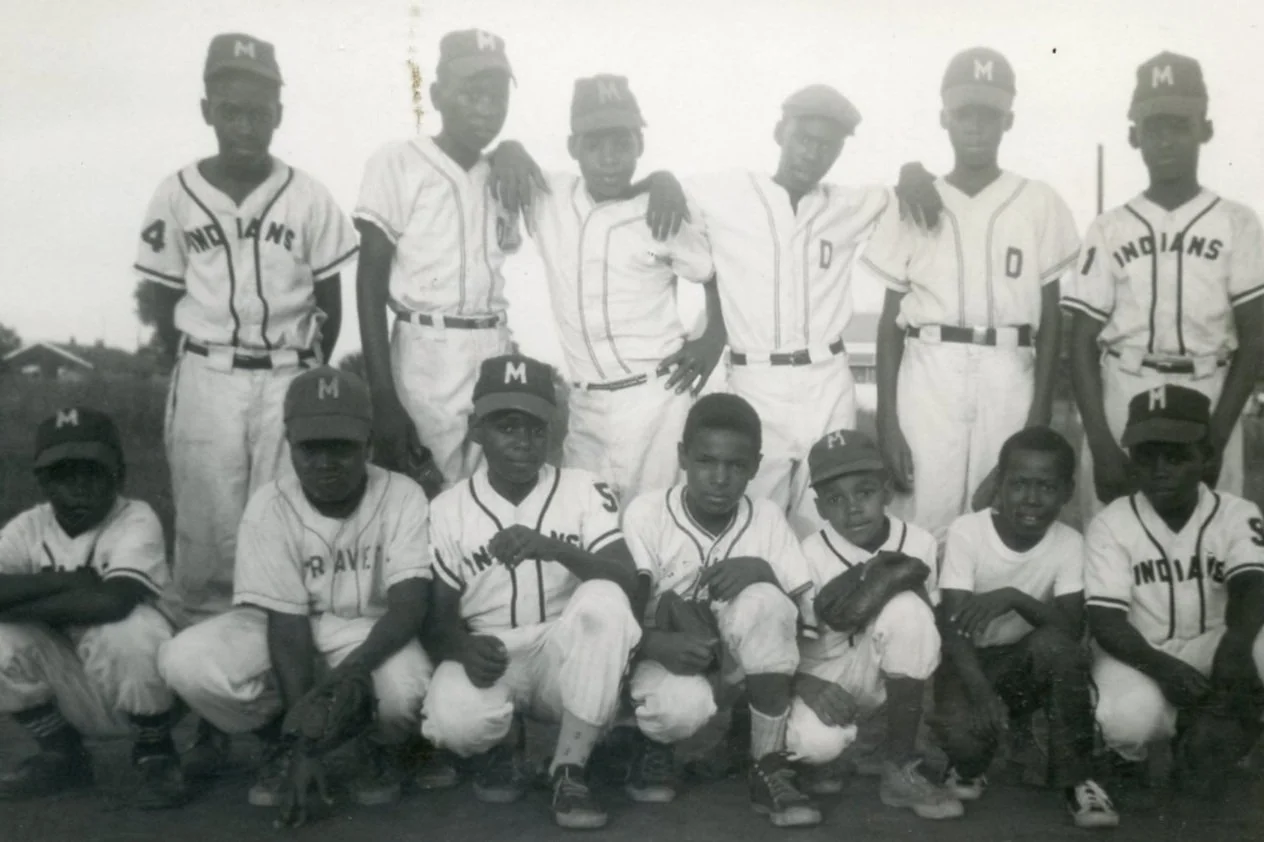
The Montevallo Indians baseball team in the early 1960s with Floyd Richardson kneeling third from the right.
Games were played on the weekends and the entire community would turn out for a full nine innings – or more. “It was an event, you know, where everybody could get out, I guess, eat, have chicken and fish and hot dogs and have some fun.”
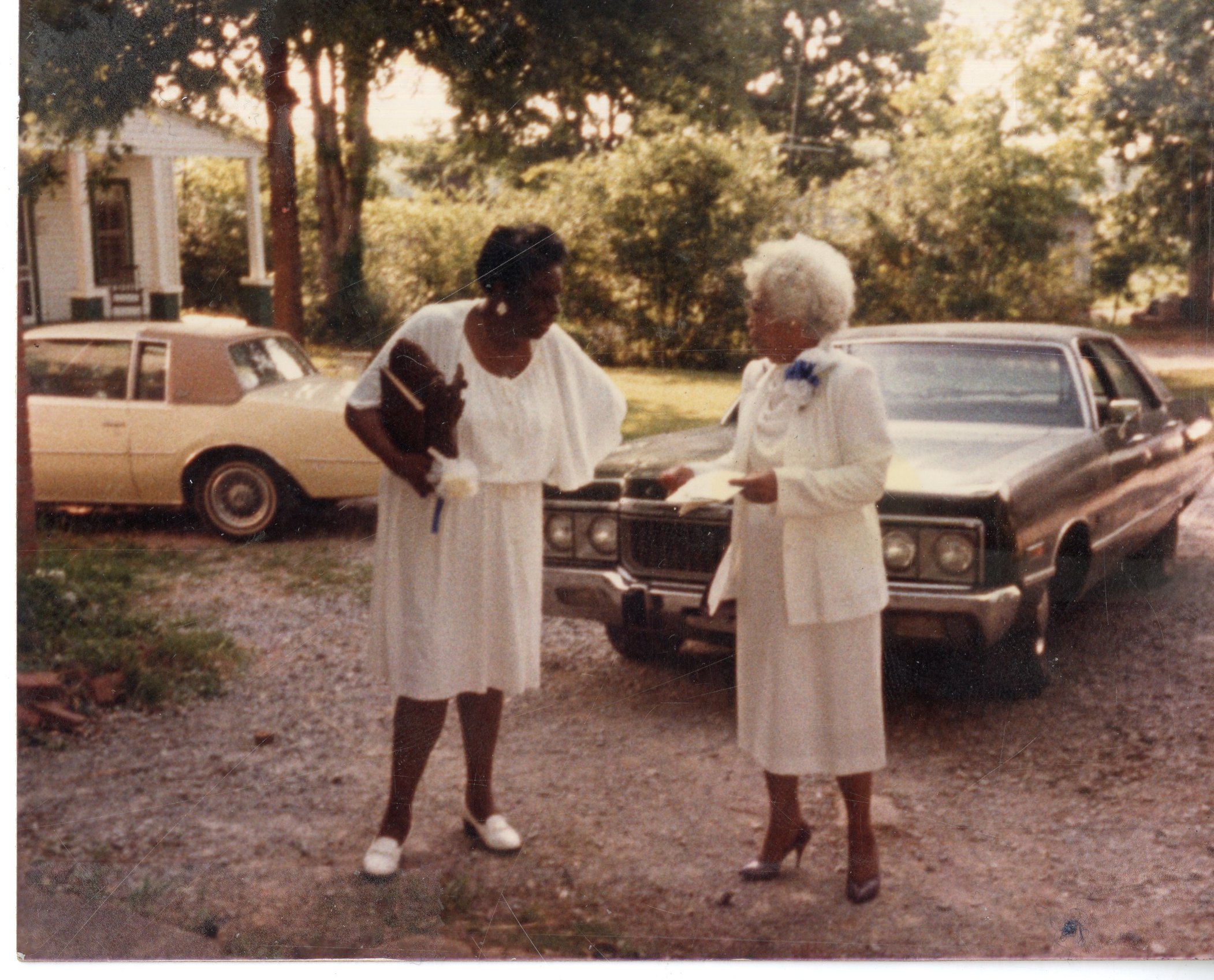
Susie Willis (left), in front of Ward Chapel AME Church, May 1985. Courtesy of James Salter.
He has warm memories of two “beautiful people,” Mrs. Susie Willis and Mr. Reggie DuBose, who were “real good to the youth in the community.” They organized summer activities: opened up the gym, organized softball, volleyball, ping pong, basketball. “Yeah, they were beautiful.”
As for interactions with the white community, they weren’t many and were shaped by Jim Crow notions of Black deference and subordination. He recalls being instructed to step aside for white people: “you had to be the one to give way, I’ll put it like that. But there wasn’t much dealing with them.” Some clerks in the downtown stores – all-white during Floyd’s time -- were nice. Others “didn’t want you to try on your own clothes, they would take a measurement and tell you what size you are instead of going into a fitting room to try them on.”
The police were all-white and best avoided. You could be sure you wouldn’t be treated fairly. He illustrated with a run-in of his own with armed police in the pool hall in the Black business district. Patrons were supposed to be adults, men only, but sometimes young guys were let it. One evening, after dark, the police raided the place. When the young guys ran – as they did “quite naturally” – the police opened fire. Sure they shot up in the air, no one was hurt, but it was “for just being in the pool room, which was crazy.”
Hear, hear! Floyd concludes that Montevallo “was a beautiful place. I had the option as a young child to either live in Michigan or Montevallo, and I chose Montevallo.”
The Montevallo Legacy Projects seeks to preserve memories that help tell a fuller, truer story of our town’s past. Let us hear from you at MontevalloLegacy@gmail.com if you have memories to share or a story you want told.